Comparing the three screens
The commissions collected, week after week
As the study is still running, this chart changes every hour with the results collected. The first shows the percentage of contributors who gave an amount to the platform. The second shows what that represents as a percentage of the amount given. The vertical line around a point is its 95% margin of error; the dotted line is the screen's average over the period shown. Choosing a schedule keeps, for the two screens that show an amount, only the payments asked at that schedule; the free amount has none and stays on the chart as the reference.
For the same amount asked, what is the impact of the screen?
This is the fairest comparison in the study. To measure the effect of the screen alone, everything else has to be identical: the same pots, the same days and the same amount asked. That is the case on participating pots since 21 September 2026: each contributor there is randomly shown either the screen or the screen, with the same schedule of amounts. We use two schedules: a moderate one (€2.50 asked on a €50 contribution) and a high one (€6 on €50). The high schedule roughly matches the average amount the other platforms on the market prefill: about 12% of a €50 contribution.
The detail, and the same figures on all pots
The impact of the contribution amount on the acceptance rate
By contribution amount, this chart shows the percentage of contributors who leave a commission.
The detail by band
The impact of prefilling
At the same amount asked, what does prefilling change?
Here we compare the screen and the screen: for each level of commission asked, what each screen collects.
Which pots take part in the study?
Since 8 September 2026, when an organiser creates their pot, we show them both screens and they choose whether their contributors can see the screen. Very few accept: of the 156 pots created since 8 September, only 21 take part, or 13%. The vast majority of organisers prefer their contributors to see the screen. Results for the screen therefore come in slowly, and it will take more time to get reliable figures. These pots are also volunteers: they are not randomly selected, which should be kept in mind when reading the results.
Results by type of pot
We inferred each pot's type from its title, then from its description when the title was not enough. It is an estimate.
The participating pots, one by one
The same figures for each participating pot taken separately. Pot names are not shown: each is identified only by its type and creation date.
Results by the organiser's age
We grouped the pots by their organiser's age when the pot was created, worked out from the birth date on their account. We do not know the contributors' ages: the organiser's only gives an idea of them, since a pot mostly circulates among the organiser's circle.
Detail by age band
Manipulating the amount shown to earn more
This part is almost a second study: it needs as many payments as possible. So it counts every contribution since 24 August 2026, whatever period is chosen at the top of the page.
At first, we only wanted to measure the impact of the interface on the acceptance rate of a commission. But analysing the results, we realised that we could in fact go much further in the manipulation.
On top of the interface, we could display and test different for each contribution amount. For example, for a €50 contribution, show €1, then €2, then €3, and see which suggestion brought in the most.
As the most used screen on Memorable is the screen, we ran the tests on it. Here is the theory, then the results.
1. Testing a different commission for each contribution amount
For each contribution amount, we vary the . In theory, the lower the commission, the more contributors accept it, but each contribution brings in little. The higher the commission, the fewer contributors accept it, but each contribution brings in a little more.
There is then an optimal level: the one at which the commission brings in the most on average per contribution. A third dimension could also be added, which we do not measure here: the satisfaction rate.
This price manipulation can go further still. We could use other information at our disposal to maximise the amount suggested:
- age: on pots organised by older people, contributors accept the commission more often (see above);
- the device: someone on a Mac may give more than someone on a PC;
- the browser: someone on Firefox may give a different amount from someone on Safari;
- the type of pot: people may give more to a solidarity project than to a birthday;
- first name and surname: we could even look for a coefficient by first name or surname;
- the email domain: someone with an @orange.fr address may give a different amount from someone with an @gmail.com one;
- the history of previous contributions…
The list of possibilities is cause for concern.
- Each curve is a contribution band:
- €20
- €50
- €100
- €200
2. For each contribution amount, we take the optimal commission percentage
In the previous sketch, each curve stands for a contribution amount, and each has its peak: the share asked that brings in the most for that amount. We plot these peaks on a single chart, the share asked against the contribution amount, and join them. This gives a pricing curve: for each contribution amount, the share to ask to earn the most.
3. Our results: the impact of the commission amount on its acceptance rate
Here is what we measured on the screen, for each contribution band. At the top, the share of contributors who leave a commission, by share of the contribution asked. At the bottom, what that brings in, as a percentage of the contribution. The diamonds place on each curve what HelloAsso, Tribee and OnParticipe prefill on average on these same contributions.
The detail by band and by share asked
4. In reality: the estimated optimal curve and the platforms' schedules
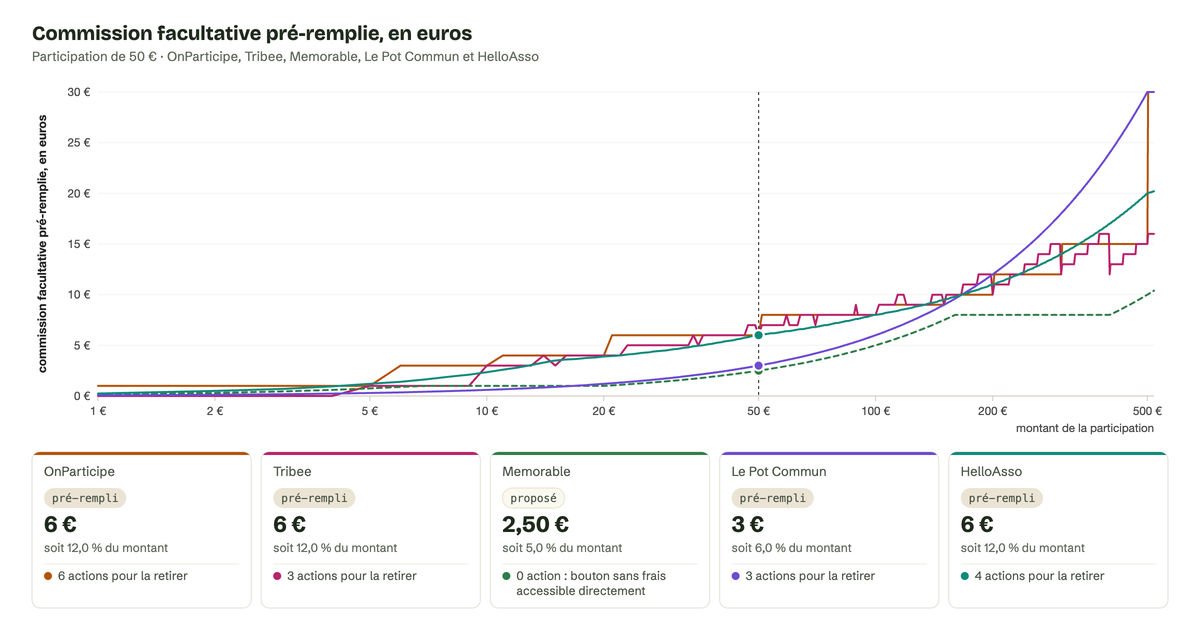
In each band, we then picked out the amount that brings in the most (the black dots on the chart) and joined these points: this is the optimal pricing curve we estimated for our own screen. Then, to put it in perspective, we added the schedules that HelloAsso, Tribee, OnParticipe, CotizUp, Donoor and Le Pot Commun prefill.
Our curve has the same shape as the other platforms' schedules: they all fall as the contribution rises, and most sit above it.
Did these platforms run such tests to arrive at these curves? We do not know. But it is possible.
The law, the method and the data
The legal framework and its sources
We bring together here the texts that could apply to the questions this study raises: how a commission is presented, prefilled amounts and interfaces that steer contributors' choices. The texts are cited as they stood on 26 September 2026; this is not legal advice. The French texts are summarised in our own translation.
| Text | What it says | What it targets in a payment screen |
|---|---|---|
| Regulation (EU) 2022/2065, Art. 25Digital Services Act (DSA), the article on manipulative interfacesEUR-Lex ↗ | Platforms must not design or operate their interfaces in a way that deceives or manipulates their users, or that materially distorts or impairs their ability to make free and informed decisions. | A general ban on manipulative interfaces, which defers to consumer law for what that law already covers. |
| French Consumer Code, Art. L. 121-17in force since 1 July 2016Légifrance, in French ↗ | Before the contract is concluded, the trader must obtain the consumer's express consent to any extra payment on top of the price of the main item. If this payment results from consent given by default, the consumer is entitled to a refund. | An amount added to the total without any action from the contributor, which they have to remove themselves to avoid paying it. The text opens a right to a refund. |
| Directive 2011/83/EU, Art. 22consumer rightsEUR-Lex ↗ | The text that Article L. 121-17 transposes. It covers the case where the trader has inferred consent "by using default options which the consumer is required to reject in order to avoid the additional payment". | The very mechanism of the pre-ticked box or the prefilled amount. |
| French Consumer Code, Art. L. 121-1unfair commercial practicesLégifrance, in French ↗ | A practice is unfair when it is contrary to the requirements of professional diligence and materially distorts, or is likely to materially distort, the economic behaviour of the average consumer. | The factual question this study measures: does a given presentation materially distort the behaviour of the average contributor? |
| European Commission, guidance 2021/C 526/01, § 4.2.7on Directive 2005/29/ECEUR-Lex ↗ | The term "dark pattern" has no legal definition; no intent is required; default settings have a considerable effect on the average consumer's decision. The guidance cites pre-ticked boxes used to charge for additional services, which it notes Article 22 of the Consumer Rights Directive prohibits. | The default setting, what the screen has already written, is named as the main lever; the platform's intent does not come into it. |
| DGCCRF, France's consumer protection authority, fact sheet « Pièges sur les sites de commerce en ligne : attention aux dark patterns ! »8 November 2023economie.gouv.fr, in French ↗ | Eight unlawful practices, including pre-selecting a paid option by default, unwanted additions to the basket and hidden information. Each case is assessed on its own; the list is not exhaustive. | Three of the eight practices describe mechanisms close to a prefilled amount, a commission counted in the total, or a claim of being free placed far from the amount. |
| DGCCRF, investigation into crowdfundingchecks in 2019, published in 2021economie.gouv.fr, in French ↗ | 51 checks on 25 businesses, notably targeting online money pots. Anomaly found: pots presented as free or fee-free, in fact funded by a commission. One official report, seven warnings, two injunctions. | The only published check on online money pots. It concerns the claim of being free and the fees charged to the organiser, not the commission suggested to the contributor. |
What does not exist yet
To our knowledge, as of 26 September 2026, no court ruling and no published sanction applies these texts to an optional commission on an online money pot. The only published investigation into money pots dates from 2019: it led to warnings and an injunction, followed by the platforms bringing themselves into compliance.
We consider that the screen does not meet the standards that the DGCCRF, France's consumer protection authority, and the European Commission hold against dark patterns: it adds to the total a sum the contributor did not ask for, and it takes three actions to remove it. That is why this screen is only shown on pots whose organiser has agreed, and why every contributor who saw it is told about the study right after paying, with the option of getting their commission back in one click.
This screen has received 53 payments, 17 of them with a commission. Of these 17 contributors, 1 asked for a refund, 3 chose to leave it and 13 have not answered yet.
At the end of the study, we will calculate the extra share attributable to this screen and pay it back to each participating pot, for the contributors who chose to leave their commission.
Method and limits
Data. The contributions paid on Memorable since 24 August 2026, the date of the study's first payments. By default, the page only counts those paid since 21 September 2026, the first day the three screens were randomly assigned side by side; the "Since 24 August" choice at the top of the page counts them all. The figures and charts are recalculated every hour; at the top of the page, they can be seen as they stood at the end of a past day.
Measures. Payments with a commission: the share of payments that include a commission above €0, at the time of payment. Commission collected: the total of commissions divided by the total of contributions, commissions excluded. 95% intervals: Wilson method for shares, linearised ratio estimator for the commission collected; two intervals that overlap do not allow concluding there is a difference.
Assignment. Each visitor is given a screen from an anonymous identifier of their browser: visitors are assigned at random and each always sees the same screen again. On ordinary pots, since 22 September 2026, 70% of visitors see the screen, with an amount drawn at random from a grid according to the amount of their contribution, and 30% the screen. Before that date, the screen followed fixed schedules. On participating pots, one visitor in two sees the screen and the other the screen, with the same schedule, moderate or high, also drawn at random; this split dates from 17 September 2026, and before that date every visitor to these pots saw the screen.
2024 survey. A questionnaire from Un Grand Jour sent in 2024 to contributors to wedding pots, 312 answers to the question Lors de votre don, seriez-vous prêt à…
("When giving, would you be willing to…"): no 196, €0.50 41, €1 42, €2 21, 1% of the gift 12. The average amount stated, set against the average amount of a contribution, gives 0.23%.
Figures announced by the platforms. Tribee announces that more than 60% of contributors leave a tip (press release of February 2025, M6 programme of 12 March 2025) and gives the example of €36 in tips on a €600 pot, or 6%. For HelloAsso, the ratio between its revenue, made almost entirely of these contributions, and the amounts collected that it publishes gives 3.1% in 2022, 3.0% in 2023 and 2.7% in 2024. Other platforms' schedules. Collected in September 2026 for our comparison of free money pots (in French), euro by euro. Le Pot Commun: the schedule of its charity pots, read in its page's code on 6 September 2026; its festive pots prefill 6% whatever the amount. The curves are smoothed: at each amount, the share prefilled on the neighbouring amounts, each counting more the closer it is.
- The pots that accept the screen are not randomly selected: the comparison of this screen holds within that group.
- It is still too early to give reliable figures: the screen only has a few dozen payments per share asked, because few organisers agree to take part. The study is still running.
- Commissions refunded after contributors were told about the study on the screen are not deducted from the rates, which are measured at the time of payment; their number is given in the box about our own screen.
- Measured on Memorable, the study does not say what happens on other platforms, whose interfaces, amounts and audiences differ. Their schedules are cited for what they are: what they prefill, not what they collect.
- The 2024 survey is a stated intention on wedding pots, not an observed payment.
- The wording was not tested. Depending on the platform, the commission is called a "contribution", a "tip" or a "service fee", and these words also have an impact on what contributors leave. We do not have time to measure everything: ideally, different sentences and different words should also be tested, one more lever for increasing the commissions collected. This variant has not been studied yet and could be the subject of a future study.
Cite this study
Memorable (2026). Study: the impact of the interface on the commissions left on free money pots. memorable.me/en/blogs/study-interface-commissions-free-money-pots.